

George W. Bush, President of the United States of America 2001-2009, was famously quoted for asking the above phrase rhetorically in a speech concerning the education system in America. First Lady Laura Bush, an educator and librarian, was spearheading an effort to focus and expand upon literacy in grammar schools. Although this was one of many gaffes that the Bush administration would be skewered over during the next two terms of his Presidency it highlighted the irony that characterized his residence in the highest office of the land; one of serious consequences yet aloof execution.
This piece isn’t about the second Bush administration or the second Gulf War that overshadowed it. It is about the quality of education and literacy in this country today and whether it is in a better state in the 21st century or if the quality and experience for youth and young adults has decreased. One may assume that with the breadth of access to the amazing resources students have these days that this would absolutely improve the ability to access information on any topic and engage in study. Students benefit from the advent of the world wide web, the ubiquitous presence of computers and technology and an expansive exposure to information not only in digital form but also through archives available to the public from libraries, museums and an assortment of institutions that are available to the public.
It isn’t that simple. Many of the same challenges face students and parents that have existed for decades. Public funding and equal access to educational resources continues to prove inconsistent and limited by local municipalities and state legislation. The pandemic that began in 2019 shuddered schools for months, isolating students from the resources that they desperately need to learn productively. Research showed that test scores dropped during the closures and progress rates suffered as well. Even students who reveled in so many days of not having to attend school eventually realized that being able to be with teachers and peers was an invaluable resource in their lives. School re-openings were celebrated by all and students eagerly returned to their classrooms. But the same problems of funding, quality and support still remain. And in the wake of our “brave new world” of social correctness a new threat has returned: book bans.
History or His-story?
Book bans are as old as books themselves. Societies have quickly discovered that the easiest way to control a population is to limit their access to knowledge. Controlled knowledge is a way of enforcing conformity while access to information that resists the body politic foments resistance. The ability to control and manipulate knowledge provides those in positions of authority the power of both access to the truth and control over dialogue. It is difficult to state a point or refute one when the evidence cannot be proven through documentation. Authority over what is written rewards “victors with the spoils”. In other words, when you are on the winning side you get to tell the story your way. But what if the winners aren’t telling the story truthfully?
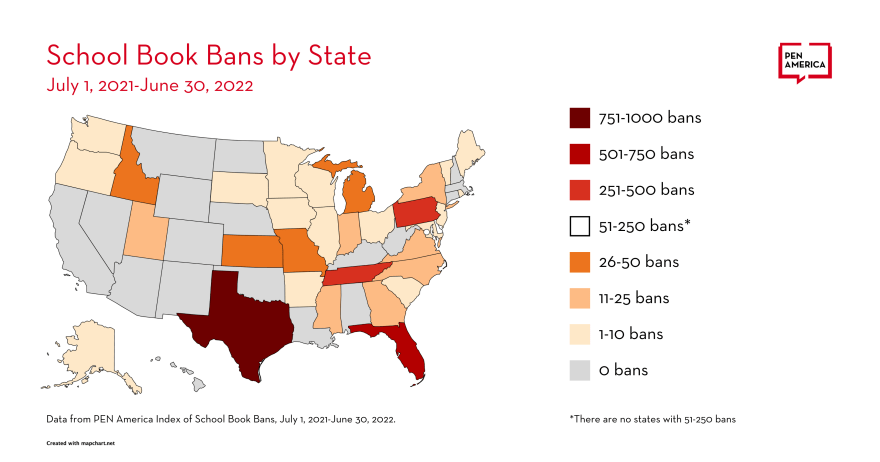
Suppression of certain types of literature has experienced increased support recently in light of the conflict of interest dealing with teaching of Critical Race Theory, Lesbian-Gay Bisexual Transgender experiences and a rising movement to amend the historical accounts of America’s most controversial practices and past. School boards from coast to coast have seen parents and conservative interest groups petition and effectively remove books on the above studies from libraries and this is not just at the grammar school level. Colleges and universities face questions as to whether they should teach classes concerning the same topics and also the nature of the material being used to teach courses. Scholars have researched and concluded that texts concerning United States history are alarmingly bereft of basic events, details and facts about key aspects that determined the course of American history. I would go as far to say that most adults have experienced similar deficiencies in how they were taught about certain topics until they attended higher education institutions or found better resources through their own curiosity. These types of limitations are insidious, however, and serve as an impediment to the acquisition of knowledge and truth. Living in a free society we value and cherish our access to information and education. Everyone should be able to read about what they want at any time. Book bans and the more troublesome instances where the truth is misrepresented or intentionally obfuscated erode the principles of freedom of speech and the public right to access unabridged history.
Book bans tend to be cyclical in nature and at the present moment they are seeing a peak in popularity. This is largely due to the extraordinarily politically charged nature of the last several years. However, book bans do have a somewhat hidden benefit. Any attempt to restrict a thing, be it an item, piece of media or concept will initially result in curiosity and eventually demand for said restricted property. Book bans will ultimately not work in the favor of those seeking their banishment. More than likely they will result in the opposite effect of kindling the curiosity of thousands of children and parents who want to learn what all the fuss is about. At the end of the whole controversy that is what restriction of knowledge is about. Who stands to benefit from taking it away and what are the consequences of providing for a more wholly educated and accepting understanding of the world at large?
“Don’t Teach Us, Amelia Bedilia”
If states and school districts aren’t going to let public schools tackle the difficult subjects, where are students going to receive the guidance they will need to navigate the complicated world of both history and social norms? At home? This is already a false assumption as few students have parents who are willing, let alone capable, to educate their children on topics of race relations and gender identity. With curriculums that are already watered down to the point of vagueness on both topics, the ongoing battle to outright remove material addressing these topics will only hobble the education system further and all but blind students in their future encounters with their peers and society at large when dealing with these subjects. They are more likely to learn from their tight circle of relations which in the public school system assumes the identity of the peers with which they associate. This is heavily dependent on the diversification that they choose through their social networks which is no guarantee of a widely representative sample of society or compassionate introduction to sensitive topics at all throughout adolescence.
It’s no secret that in heavily red or conservative states the movement to ban books and restrict curriculum has been spearheaded by Republican legislation and devout Christian groups. Florida and Texas have blazed a path in scripting policies of this type and several other states have followed suit. Pushing back against the “woke agenda” has its consequences though. Along with foisting one generation’s political frivolities upon another, it also sells them short of an experience that previous generations did experience and thus should inherit a more open-minded and diverse set of values than the current zeitgeist is dictating. Knowledge suppression is a form of fascism, which ironically, the conservative right would have everyone believe that the teaching of subjects such as the legacy of slavery and LGBT equality is attempting to poison society with. It is the old trick of one proponent playing the “do as I say, not as I do” card.
Finally there is the age old fact of the incredible disparity between society’s demands on education systems and funding. In times of war when an invading army wants to isolate a community and cripple its resources one of the first strategies they undertake is to destroy the school and round up the educators. This is effective in that these are the people who are most likely to inform, organize and direct resistance. The United States is not at war with itself, but crippling the educational system is on par with declaring war against elements of our own society. It is no secret that education has ranked as one of the lowest expenditures of the national budget historically. Even in the 21st century there are rural areas of the country that do not have access to the internet or global information as any metropolitan area would be expected to. Then there is the fact that school budgets struggle to maintain or retain educators. Almost all 50 states report shortages of teachers in fields such as mathematics and science. Nationwide up to 30K teaching vacancies may exist annually. And when you compare the salaries of educators at the K-12 level they represent a marked difference from similar wages made by those with a college degree in other fields of profession. In short, the U.S. does not pay its teachers. This is the final piece of the equation as far as neglect of the education system goes. And when we once again have an economy in decline with less and less students enrolling in college, less well qualified applicants for positions requiring a degree and more jobs lost overseas in preference of cheaper educated labor forces we will have only ourselves to blame. Not that this will all stem from banning books, but actions such as these are symptoms of a more endemic problem with the education system. A society that values its worth and values its future must invest in education and free access to knowledge of all kinds.
“You don’t have to burn books to destroy a culture. Just get people to stop reading them.”
-Ray Bradbury
 VitriolBlog